








TBC RELEASES NEW FEEDBACK REPORT TEMPLATE
The Booth Company, an international provider of 360 feedback surveys, announces the release of its new feedback report template. Survey results will now... .


Flash player 9.0 is required to view the 360 feedback walkthrough.
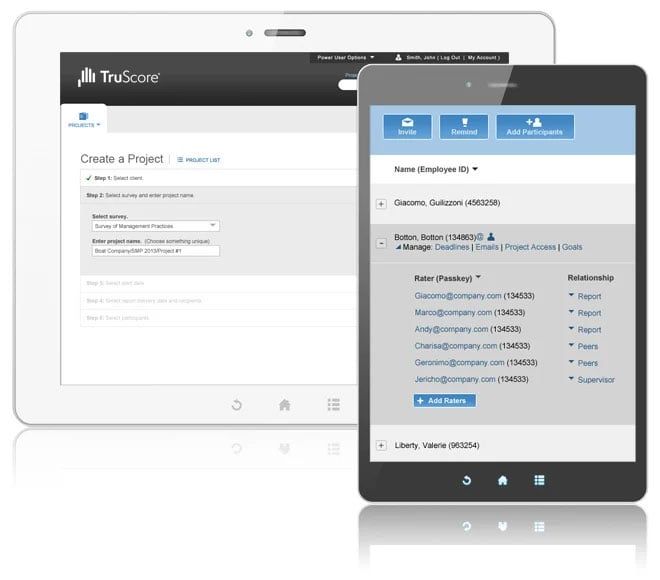
The 360 survey demo will walk you through the survey process from the participant's perspective. All participant activities during a feedback project can be handled online through TruScore™, via one interface.

TruScore™ is an online application that provides a platform for designing, implementing, and managing simple to complex survey programs. The administrative control and flexibility provided by TruScore is all you need to easily and efficiently accomplish your survey needs.

ReVolve newsletters provide you with industry relevant information in the form of white papers, case studies, book reviews, or just interesting trends and random tidbits that will bring value to your inbox.

Sign up today! >>

    Click on a link below.


    What is 360 Feedback?
    Also known as multi-rater feedback, 360 feedback involves collecting perceptions about a person's behavior from those around them. The feedback can come from the person's manager, peers, direct reports, and even external stakeholders such as customers, suppliers and board members. The feedback can then be used as the starting point for action planning, or to plan training and set development goals.


    What are the benefits of 360 feedback?
    A 360 program provides benefits for both the individual and the organization. The broad scope and fairness of the feedback provides an accurate and well-rounded view of how others perceive an individual's efforts. Getting a clear picture of performance helps identify weaknesses that need to be improved as well as strengths that can be leveraged. Knowing the skills that need improvement is the first step toward creating a plan of development for the short and long term.

    In an organizational setting, 360 feedback can renew focus on goals and objectives, encourage constructive feedback, and clarify the roles of managers, leaders and individual contributors within the organization. This facilitates an environment that encourages self-development, which leads to job satisfaction, minimizing turnover and the costs associated with replacing employees.


    How do I choose a 360 vendor?
    Choosing a 360 vendor should be a deliberate and well researched step. Today many 360 companies are popping up overnight and creating 360 surveys with little experience in the field. Such companies do not offer sound products and services resulting in poor ROI by your organization and a bad impression of 360 Feedback. This is unfortunate because 360's were created to generate positive change within an organization by focusing on confidential career development of it's leadership talent.

    To help you avoid choosing an inadequate vendor we have put together the below criteria. Whether you are looking at TBC or another 360 vendor the below criteria will ensure that you and your organization will have a successful 360 program.

    • Confidential development
      An organization should make sure that it is doing 360 reviews for the right reasons. It should be used for developmental and not appraisal purposes. The two purposes are incompatible.
    • All questions are not alike
      Survey questions should be clearly focused and specific around a particular set of skills, competencies, or behaviors. Competencies can be improved through proper training and coaching; personality attributes can be changed only through long-term counseling.
    • Anonymity
      Rater anonymity is key to the success of a 360-degree feedback program. Ensure you are choosing an instrument that guarantees confidentiality (including the open-ended comments). Anonymity will lead to more honest and open feedback from the raters.
    • Reliable and valid
      Without a doubt, the 360 instrument needs to be tested for reliability and validity. This means the 360 should measure what it proposes to measure, consistently and accurately. A well researched instrument will also be normed against a statistically valid database.
    • Don't choose on cost alone
      Low-cost is a false economy when purchasing a 360-feedback instrument. It takes years to develop a good one. There are many instant "experts" on 360-feedback that generate custom questionnaires overnight. View 360 as an investment in the organization's future performance.
    • Training and development
      Make sure that follow-up training programs accompany the 360 program. This can be done through one-on-one coaching, or group facilitation. 360-degree feedback without training is seldom, if ever, successful. A good training program will guarantee a strong return on investment.
    • Reassessment
      Don't limit yourself to an instrument created for a one-time use. As useful as it is to take a 360 the first time, it's the 2nd and 3rd times when one can also measure progress. Choose a 360 program that allows you to compare scores over time, knowing that continuous improvement requires constant measurement.


    What are centiles?
    Also known as percentiles, centiles are a method of statistical measurement that refers to the percentage of people whose score falls at or below a certain value. In the feedback report, raw scores are converted to a percentile scale. At the 30th centile, for example, it is estimated that 30% of the norm group would score at or below the raw score.


    What are norms?
    Rather than relying completely upon raw scores when analyzing feedback, a combination of norms and centiles is used. Norms can be thought of as performance benchmarks to help interpret results of the feedback more effectively. Viewing the feedback in the context of a larger population of managers is essential for a full understanding of the data.


    What is the Task Cycle®?
    The Task Cycle® theory is the architecture for all Clark Wilson surveys. It is a validated model of successful management and leadership practices for each individualized role. Its intuitive logic about where to find leverage as a leader provides an easy transition from feedback to performance improvement. See more on the Task Cycle® >>


    What role does coaching or follow-up training play in the 360 process?
    Coaching or follow-up training is an essential part of any feedback program. 360 feedback without one-on-one coaching or group facilitation is seldom, if ever, successful. A good training program will guarantee a strong return on investment. See more on coaching >>


    What is the purpose of having role specific surveys?
    Survey questions should be specific and clearly focused around a particular set of skills, competencies or behaviors. Surveys designed for a specific role in an organization will effectively measure competencies relevant to the role.


    What is 720® degree feedback?
    720 Feedback® provides a comparison of a participant's results over a period of time, often 12-18 months. This comparison informs participants of their developmental progress and gives them an opportunity to update and change their action plan. Tracking progress over time has been a "best practice" common to high-performing leaders.


    How are surveys validated?
    Validation of an instrument means that individuals and organizations can make reliable strategic decisions, based on survey results, about where to focus their development efforts.

    In order for an instrument to be valid it needs to be compared to another measure. In most cases the other measure is internal performance within the organization such as rate of promotion, bonus as related to salary, etc. If there is consistant high correlation between an assessment measure and the performance measures internally then the instrument is valid.


    Why is confidentiality and anonymity so important in 360 feedback?
    Rater anonymity is a key part of a successful 360 feedback program. An instrument that guarantees that answers will remain confidential will lead to more honest and open feedback from raters.


    What is an action plan?
    An action plan, also known as a development plan, is a plan for developing or improving skills that have been identified as being an area of improvement. Action planning involves identifying areas for improvement, defining indicators for success and necessary resources, and setting out actions and a timeframe to meet the improvement goal(s).


    What is a group report? How is it useful?
    Group reports, also known as aggregate reports, present a "macro" view and analysis of performance across a group of feedback participants. Group reports compile data from a set of people, identifying the strengths and development opportunities of the group as a whole, as well as tracking improvements from the previous 360 assessment process. Organizations often use this data to aid in creating a training needs analysis for the group.


    Is creating a custom 360 survey difficult?
    We can easily adapt our instruments to meet your organization's unique needs. If you wish to modify an existing Clark Wilson Task Cycle® survey, our development team will work with you to design a custom survey that meets your expectations, while preserving the reliability of the competencies.

Copyright The Booth Company (360 Feedback Provider). All Rights Reserved.  |  Legal  |  EU Safe Harbor Policy  |  Site Feedback  |